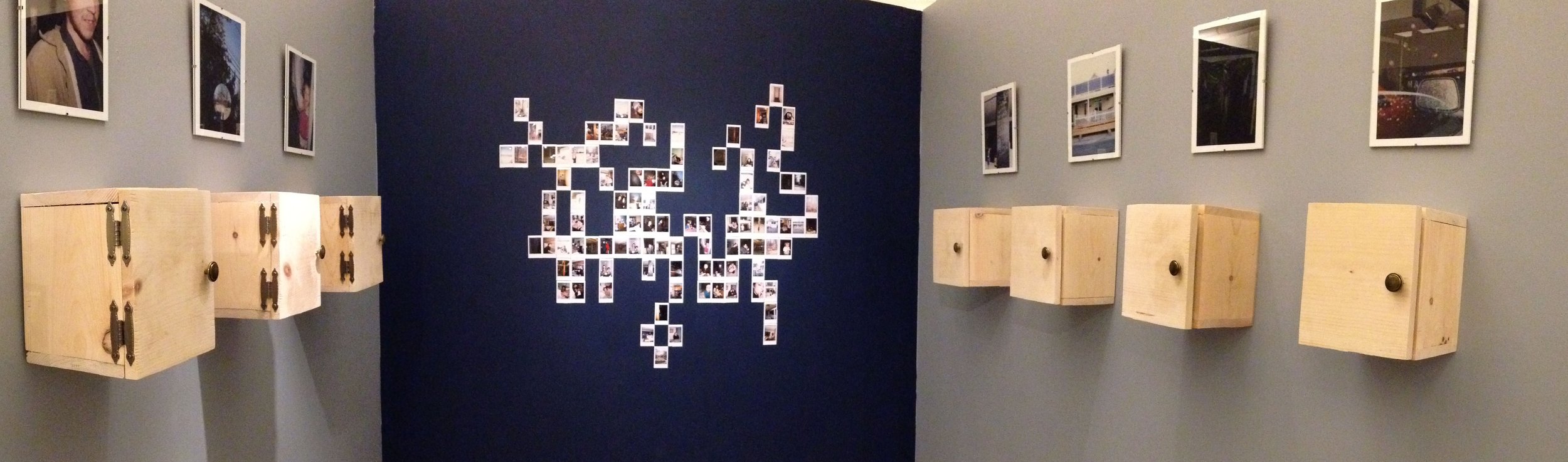
“Can I Go Home Now?” 2013

Can I Go Home Now? is an installation exploring trauma, vulnerability, and the unspoken social boundaries surrounding honesty. At its core, the work asks a simple question: How much of a stranger's truth are we willing to carry?
Over the course of five months following Superstorm Sandy, I documented my surroundings through a series of one hundred Polaroid photographs. The storm had devastated my hometown of Long Beach, New York, displacing families, destroying homes, and altering the lives of people I loved. Simultaneously, I was witnessing other deeply personal experiences: my grandmother's decline from dementia, a cousin struggling with active drug addiction, and my young niece navigating circumstances no child should have to endure. Yet among these images of loss and uncertainty were moments of laughter, tenderness, and levity—the ordinary contradictions of life continuing in the midst of upheaval.
From the collection, I selected seven photographs to enlarge, each accompanied by a personal letter addressed to the people or moments depicted. These letters were concealed within structures made of unfinished wood, echoing the raw building materials being used to reconstruct my own storm-damaged home. The materials became both a physical and symbolic reference to the process of rebuilding, while the hidden letters offered viewers an opportunity to engage with the experiences beyond the photographs.
The decision to read these letters was left entirely to the viewer.
In our everyday interactions, we constantly negotiate how much of ourselves we reveal. Familiar exchanges such as "How are you?" or "How have you been?" are often governed by unspoken social expectations. We ask questions without necessarily anticipating honest answers, and we respond according to what we believe others are prepared to hear. Beneath these ordinary exchanges exists the reality that everyone carries experiences invisible to those around them. At any given moment, one person may be seeking to share a burden while another may not have the emotional capacity to receive it.
I was creating this work while actively experiencing trauma, under the immense pressure of producing my final undergraduate exhibition. At that moment, my own experience was the only subject I felt capable of approaching with complete honesty. Yet I had no desire to position myself as a victim or demand an audience's sympathy. Rather than presenting a fully disclosed narrative, I wanted to create a space in which vulnerability could be offered without being imposed.
Can I Go Home Now? ultimately examines the exchange between the person revealing their truth and the person choosing to witness it. The concealed letters allowed viewers to decide whether to move beyond the surface of an image and enter a more intimate encounter with another person's reality.
The work was not simply about being seen or understood, but about allowing someone else to decide whether they were willing, and able, to listen.